
Finding Pittsburgh Residents
Pittsburgh does not keep a single public roll of every household. Start with the kind of fact you need to test. An address can lead to the Allegheny assessment record, parcel identifier, and recorded land documents. A full name and a date can be tested against a court docket, a marriage record, or a dated library directory. Each record answers a limited question. Pittsburgh research gets stronger when each record is read for its own limited purpose. A deed names document parties, for example, but does not establish that either party now lives at the property.
Use independent facts to narrow common names. A ward, a municipality, a marriage year, a case number, a parcel identification number, or an old street address can keep two people with the same name from being merged. County and state custodians also offer counter, mail, phone, form, and archive routes when an online search does not answer the question. A missing online result is not proof that the underlying record never existed.
- For a known Pittsburgh address, use the County property portal to capture the physical address, PIN, sale clue, and mailing-field distinction.
- Carry the PIN or recorded reference to the DRE land-record index for a dated grantor, grantee, deed, mortgage, or plan search.
- For a name with a local court connection, narrow the Pennsylvania UJS Case Search to Allegheny before adding dates, case type, or status.
- For an older Pittsburgh household, check the nearest verified Carnegie Library directory volume and preserve the spelling, address, and year.
- Ask the record custodian, library, court division, or archives for the documented fallback route when a portal cannot supply the needed record.
Pittsburgh Resident Records Offices
Allegheny County holds the property, land-record, court, marriage, probate, and election channels that most often help identify a Pittsburgh resident record. The City keeps administrative archives and address-related permit material. Pennsylvania agencies hold statewide vital, court, voter, licensing, and archives resources. The office that owns the record is the right place to confirm a result, request a copy, or correct an error. Address-led records require a more focused street-level sequence.
Allegheny County DRE
Room 101, County Office Building
542 Forbes Avenue, Pittsburgh, PA 15219
412-350-4224
Office of Property Assessments
County Office Building, third floor
542 Forbes Avenue, Pittsburgh, PA 15219
412-350-5024
Allegheny Elections
Suite 312, County Office Building
542 Forbes Avenue, Pittsburgh, PA 15219
412-350-4500
Note: A County office can explain its own record, but court files, vital certificates, and archival materials follow separate access rules.
Pittsburgh Address to Parcel Trail
Allegheny County uses a three-part handoff that matters in Pittsburgh resident research. The public Real Estate Portal is the assessment starting point for an address or PIN. County GIS then supplies parcel geometry and identifiers such as PIN and map-block-lot, while the Department of Real Estate supplies the recorded document sequence. GIS is useful for locating a parcel, but its public parcel layer has no owner field. Move from the map to the property record, then from the property record to DRE when the question is title history.
The County address-and-parcel search is shown below. It accepts an address or parcel number; County guidance says to omit street suffixes such as Street or Drive and to leave municipality blank when it is unknown.
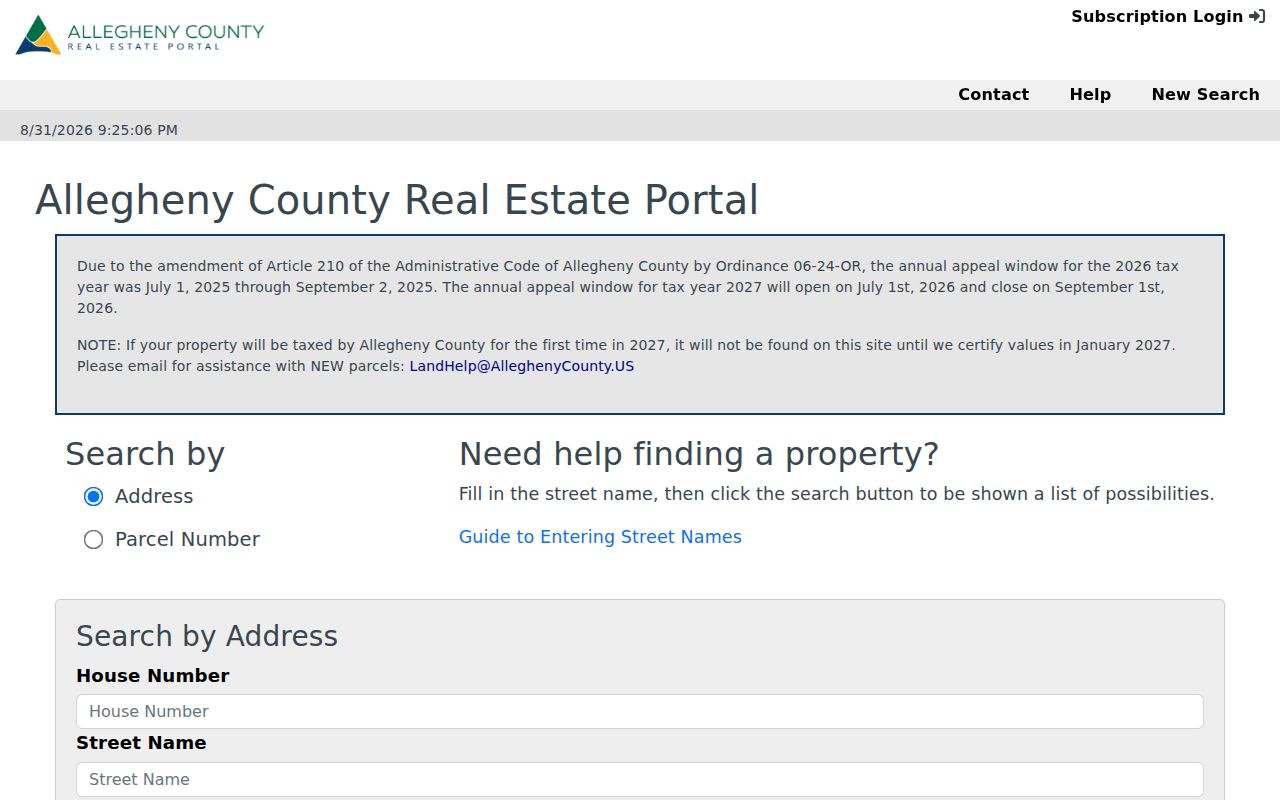
After finding the parcel, record the PIN and the physical, owner-mailing, and tax-mailing fields separately. They serve different functions and should not be treated as the same address.
- Parcel
- A defined piece of land used in County assessment and mapping systems.
- PIN
- The County parcel identification number, which can bridge the property screen, GIS, and DRE search.
- Index
- A finding tool that points to a record; it is not always the document image itself.
- Resident roll
- A source that records people for a particular purpose, not a universal household list.
Pittsburgh Property Records Need Checking
Property results can be a strong Pittsburgh lead, but they need careful reading. The printable County property-card schema includes assessment, building, tax, recording, sale, owner, and mailing data. It does not turn the assessment screen into a current-household list. The County warns that its owner-history display is incomplete, and a Homestead value marked YES can remain after a sale or deed change. DRE is the source to check for the fuller recorded sale and title trail.
Allegheny DRE quick search supports a general search term, recorded-date limits, and index-only or index-and-full-text modes. The advanced screen also allows party, grantor, grantee, document number, book/page, and PIN searching. Historic County documents date to 1788, while the State Archives identifies a grantee-index microfilm run through 1904. Image availability must still be checked for the particular record.
The DRE land-record search shows the official entry point for that document trail.
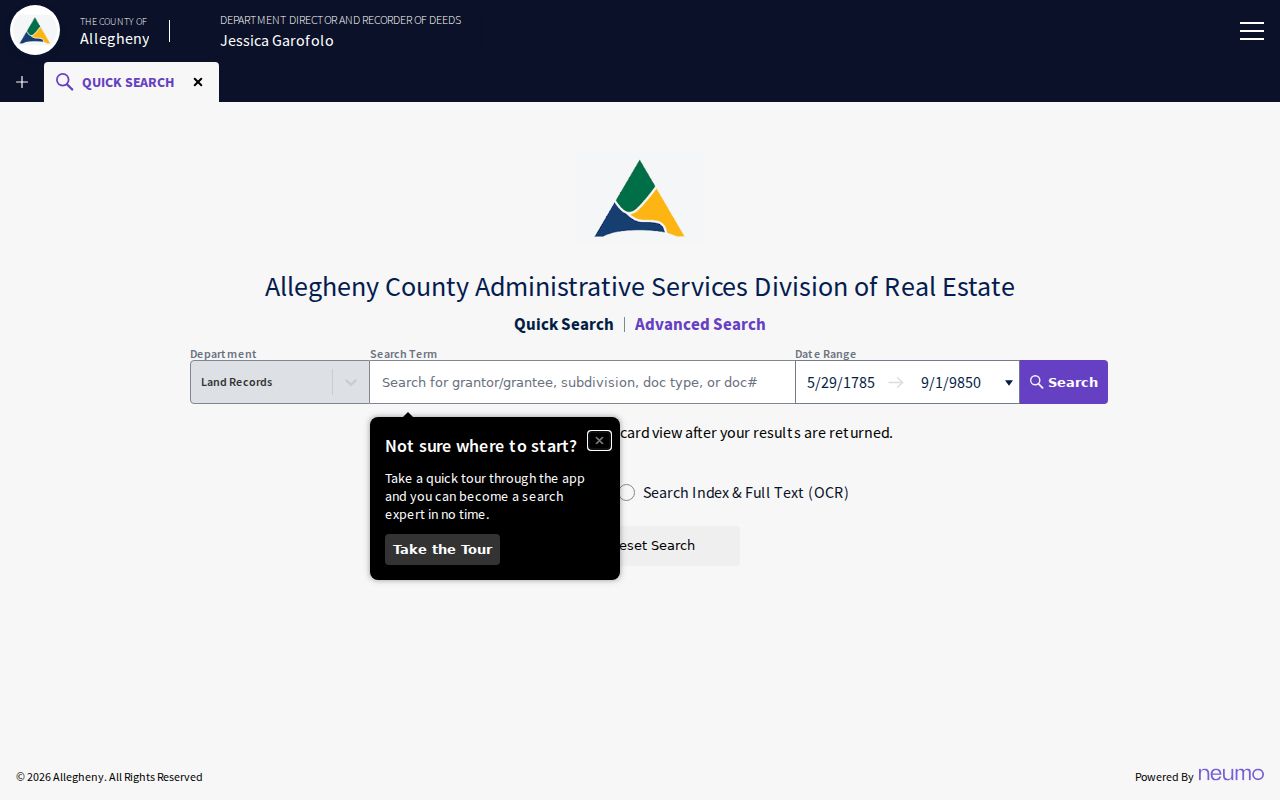
Use a precise PIN, party name, date, book/page reference, or document number when available, then verify the document image or counter copy for the record at issue.
| Official source | Best local question | What to keep distinct |
|---|---|---|
| Property Portal | Assessment and address/PIN facts | Physical, owner-mailing, and tax-mailing fields |
| County GIS | Parcel location, PIN, and MBL | Geometry is not an owner record |
| DRE Land Records | Recorded title and document parties | Document party is not current-residency proof |
Note: Verify a sale or ownership question with the recorded document and the appropriate custodian rather than a single display field.
Pittsburgh Court Dockets by Name
For a Pittsburgh name search tied to court activity, the free Pennsylvania UJS Case Search is the starting point for the Fifth Judicial District. Enter the participant last and first name, then choose Allegheny County or Judicial District 05 before adding a date, docket type, or status filter. A docket can confirm a case caption, participant role, court, number, dates, events, charges or dispositions, and financial entries. It is not a complete court file or a general certificate about a person.
The official UJS search screen illustrates the statewide starting point. Its search choices include participant name, docket number, citation number, case date, organization, parcel, and several court or calendar fields.
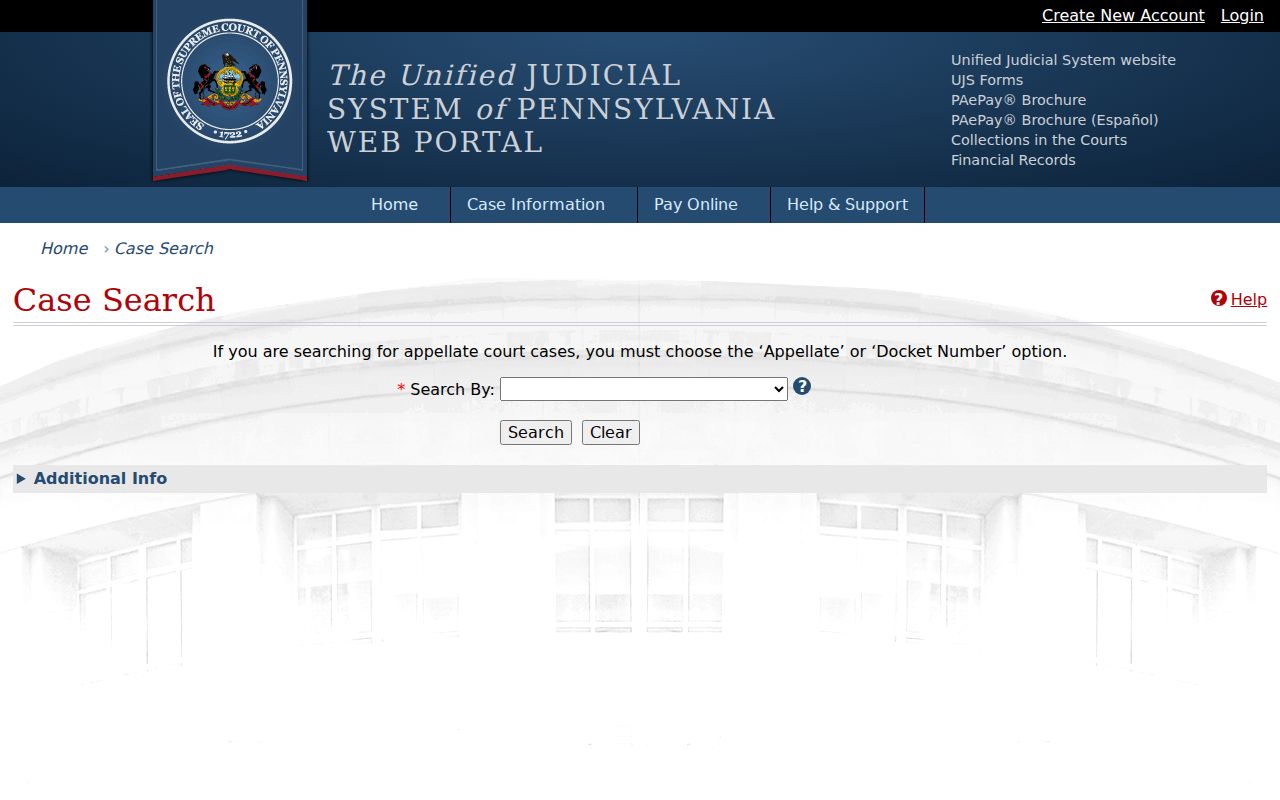
Recent entries can be delayed. Juvenile, sealed, expunged, limited-access, and other restricted material is not displayed publicly. Court Administration and the relevant court division remain the route for permitted file access.
Current Pittsburgh Resident Directories
Current Pittsburgh resident directories are purpose-built records, not one combined database. The assessment portal can associate an address with property facts. DRE identifies parties to recorded instruments. The state registration-status service is an individual-status channel, while formal voter lists use a separate request form. Court, marriage, probate, license, and business channels may confirm a narrower dated fact. For name-based verification across these sources, use the Pittsburgh resident lookup process rather than relying on one result.
| Resident source | What it can confirm | Custodian | Access route |
|---|---|---|---|
| Property assessment record | Address, parcel, assessment and mailing clues | Allegheny OPA | Public address/PIN portal |
| Recorded land index | Grantor, grantee, date, type, book/page and PIN | Allegheny DRE | Online index, counter, or mail |
| Registration status or voter list | Individual status or statutory list fields | PA Department of State | Status channel or formal request |
| Marriage and probate records | Dated identity or estate lead | Allegheny Court Records | Order, counter, or scoped form |
| Historic directory collections | Dated name, address, and occupation clues | Carnegie Library and Historic Pittsburgh | Microfilm, digital collection, or research help |
Pittsburgh Voter Access Routes
Pennsylvania offers two distinct voter channels that should not be confused. The online registration-status service is for an individual status check and can also be reached through the County elections office. It is not a public street browser. A formal Department of State request form offers Public Information, Street, Walking, and Full Voter Export lists. The Street and Walking lists are the documented by-street route, but each carries identification, affirmation, permitted-use, and publication restrictions.
Pennsylvania’s registration-status service provides the individual check route. When formal list access is appropriate, the state form identifies a $20 fee for the Public, Street, and Walking lists per county and says the request goes to the Department of State.
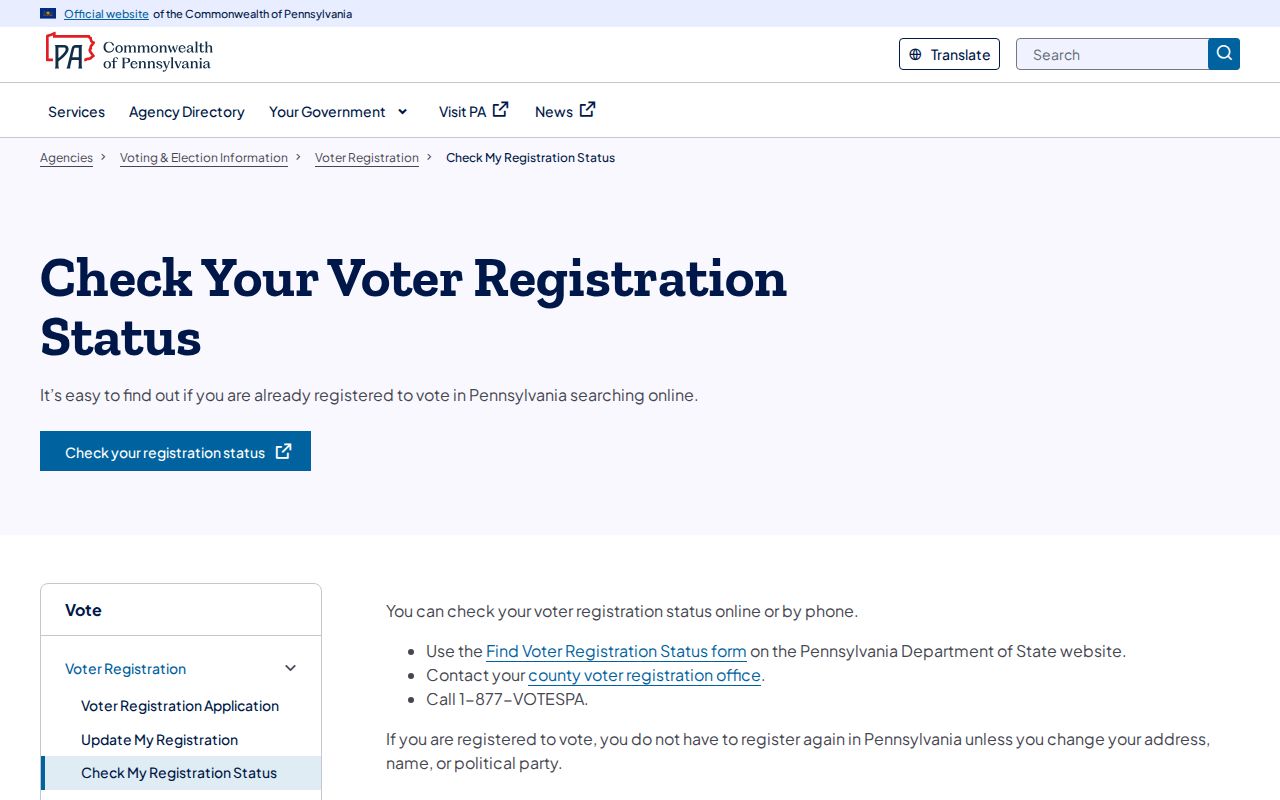
Protected voters may use an alternate public mailing address. Do not republish formal-list data or use it to target, track, harass, or intimidate anyone.
Pittsburgh Vital Record Access
Vital records can help with a Pittsburgh family-history or estate question, but they do not prove a present address. The Pennsylvania Department of Health holds births and deaths from 1906. Birth records become public after 105 years and death records after 50 years under the Vital Statistics Law, 35 P.S. §450.801. For more recent certificates, eligibility, identification, a signature, and the Department’s form controls apply. The Department’s historical genealogy route and PHMC indices are the archive path for eligible older records.
Pennsylvania Vital Records is the ordering gateway for birth and death certificates. Allegheny marriage records begin in 1885; the County route needs one spouse’s complete application name and the marriage year, with online search and order available for 1996 and later licenses.
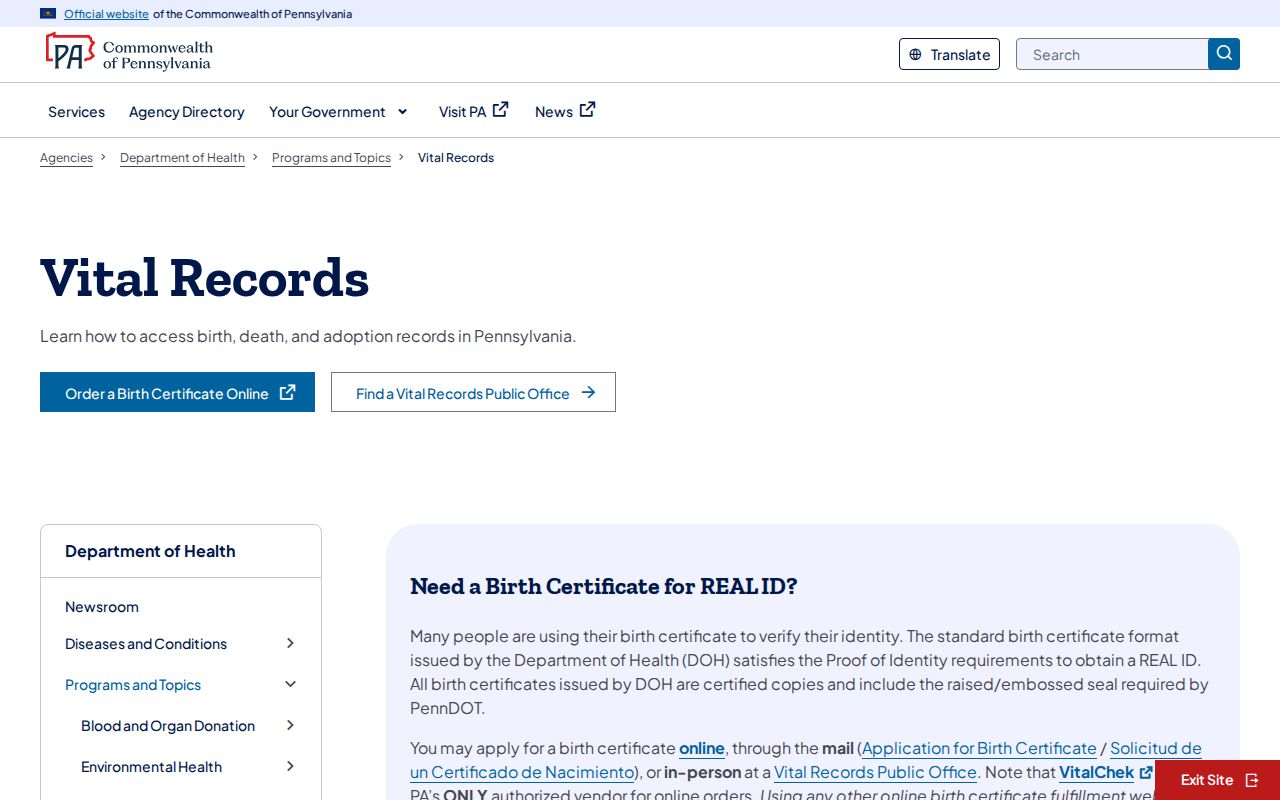
Use the archival, certificate, marriage-office, or court-file route that matches the date and record type. A dated vital or marriage record needs a second source before it is treated as current-residency evidence.
Historic Pittsburgh Resident Directories
Carnegie Library of Pittsburgh’s Pennsylvania Department has a documented Pittsburgh city-directory microfilm run beginning in 1813 and reaching 1975, but the holdings contain real gaps. The verified volumes include 1813, 1815, 1819, 1826, several nineteenth-century years, 1856–1874, 1876–1932, 1934–1962, 1964–1965, and 1967–1975. Historic Pittsburgh also describes a digital directory collection of personal and business names and addresses. Check the metadata of the individual volume before assigning a year.
For historical work, retain the exact name spelling, initials, occupation, address, and year from the volume. Compare the nearest available volume on either side of a gap, then use a census date, recorded deed, map plate, or archive request to test the household trail. The fuller collection and entry-reading method is available through the Pittsburgh city directory.
Pittsburgh Neighborhood Record Keys
Pittsburgh has 90 neighborhoods, but neighborhood names do not replace the keys used by public records. Official neighborhood and ward maps provide civic context, while County property and GIS systems rely on the physical address, municipality, PIN, and map-block-lot. Postal ZIPs follow another geography. A person looking for a property, permit, directory, or parcel result should keep each identifier with the date and source that produced it. That makes it easier to test whether two results describe the same place instead of joining nearby but distinct Pittsburgh addresses.
Topography adds a local complication. Pittsburgh’s hills and rivers separated development into neighborhood street systems that often do not connect, so a street name alone can be a weak historic locator. Pair the name with a ward, plan, lot, parcel identifier, municipal name, or same-era map. The Pittsburgh Neighborhood Snapshots resource can help place an address in civic geography, but it is not a resident list and cannot establish ownership or occupancy. For a property question, the County parcel and DRE trail remains the appropriate evidence chain.
Note: Keep a ZIP, neighborhood, ward, street, and parcel number as separate fields because each describes a different Pittsburgh record geography.
1845 Pittsburgh Record Detours
Pittsburgh’s Great Fire on April 10, 1845 is a local records caution, not a reason to abandon a search. The historic City Council collection guide says the fire destroyed the mayor’s office and most City records from 1843, while Fire Relief Committee material from 1845–49 survived. County deeds and probate, library directories and newspapers, historic maps, and City archival material can provide alternate evidence for the affected period. The fire did not destroy County records.
For surviving City material, the City Clerk’s Records Management Division offers a public archives catalog and digital collections. The City describes more than one million digitized pages of meeting minutes and reports, along with photographs and selected audiovisual material. Catalog searches can be narrowed by terms, record type, search field, and year range. A catalog hit is an archival or administrative lead, not a claim that a named person lived at an address. When an online record is not enough, City Archives accepts research requests by phone or email.
Older geographic clues need the same care. Pittsburgh’s hills and rivers produced disconnected neighborhood street systems, so a street name alone may not identify the historical location. A ward, plan, lot, legal description, or map reference can make an old address much more reliable.
Note: Preserve the original historical address as written before reconciling it with a current map or parcel identifier.
Pittsburgh Right-to-Know Requests
When a City or County agency holds a Pittsburgh administrative record that is not online, Pennsylvania’s Right-to-Know Law, Act 3 of 2008, 65 P.S. §§67.101 et seq., supplies a records-request path. Send a specific written request to the agency that holds the record. The law generally requires a response within five business days; an interim response may extend the process within the statutory limits. Courts, vital records, voter data, 911 material, and Address Confidentiality Program records follow their own rules and should not be requested through the wrong channel.
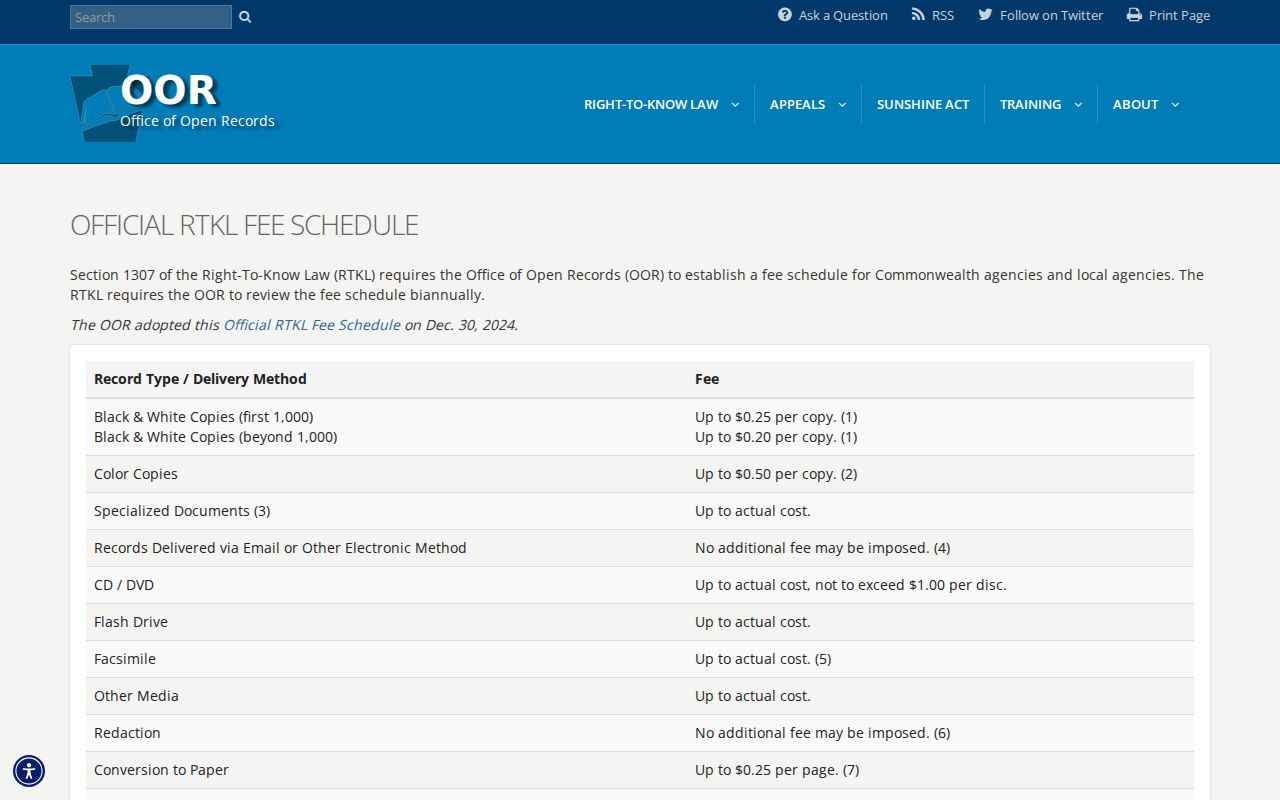
The Pennsylvania Right-to-Know fee schedule lists electronic delivery without a fee, ordinary black-and-white copies through 1,000 pages at up to $0.25 per page, and prepayment when an estimate exceeds $100. The City accepts in-person, mail, email, and fax requests through its Open Records process, not phone requests.
A request should identify the record, date range, and custodian with enough detail to allow a search. If the record belongs to a court, library, archives, or vital-record office, use that channel’s published form or service instead.
Verify Pittsburgh Deed Records
Deed and title questions deserve direct verification. In February 2026, the Pennsylvania Attorney General warned residents about forged deed or title transfers and deceptive signing schemes. First compare a suspicious claim with the County DRE reference and the original recorded instrument. Allegheny’s Property Fraud Alert can send an email notice when an instrument matching a registered name or keyword is recorded. It is a notification service, not a guarantee that fraud will be prevented or that all information is complete.
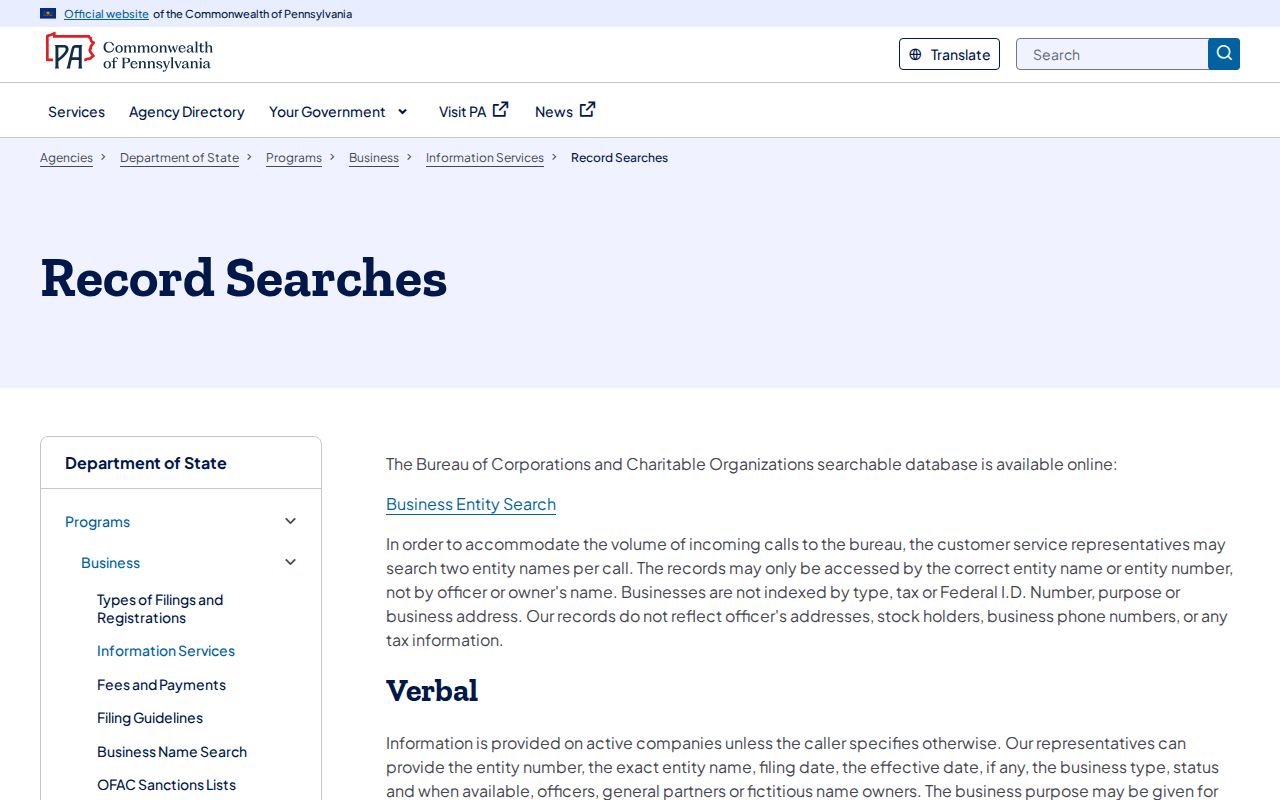
Pennsylvania business-record search guidance is another example of a limited official index: it is entity-name or entity-number driven, not a broad person search. Entity dates, status, and available public roles can help distinguish a business fact from a personal-residence claim.
Lawful use. Pittsburgh records support personal, family-history, estate, property, and civic research. Do not use names, addresses, or record details to stalk, harass, intimidate, or harm another person.