
Pittsburgh City Directory Shelf Access
Carnegie Library of Pittsburgh's Pennsylvania Department has a documented microfilm holding for Pittsburgh directories, but the holding is not a claim that every year exists. The exact list begins with separate volumes for 1813, 1815, 1819, 1826, 1837, 1839, 1841, 1844, 1847, and 1850. It then lists runs for 1856 through 1874, 1876 through 1932, 1934 through 1962, 1964 through 1965, and 1967 through 1975. For a Pittsburgh city directory search, select a real volume closest to the date rather than filling a gap with an assumed annual edition.
| Collection | Years | Where held | Access route |
|---|---|---|---|
| Pittsburgh directory microfilm | 1813 to 1975, with listed gaps | Carnegie Library Pennsylvania Department | Verify the needed Pittsburgh volume from the library list. |
| Historic Pittsburgh directories | Collection described as 1815 to 1945 | Historic Pittsburgh digital collection | Online Pittsburgh collection metadata and item images where the viewer permits. |
| Pittsburgh telephone directories | Holding listed, no year span captured | Carnegie Library list | Use as a later Pittsburgh name and address check. |
| Pittsburgh Business Directory | 1854 | Carnegie Library list | Pittsburgh business and address context, not a household census. |
| Pittsburgh Bulletin | 1895 to 1949 | Carnegie Library list | Pittsburgh notice and chronology lead. |
The Historic Pittsburgh directory collection describes more than 120 personal and business volumes, chiefly for Pittsburgh and Allegheny City, with some nearby borough material. Its collection description says 1815 to 1945, while its FAQ describes 1837 to 1930 with gaps. Keep both statements intact and use an item's own metadata before assigning a year to a person or address.
Historic Pittsburgh's digitized-directory collection is the source for the capture below.
The capture records the collection access point. A live visit may require normal browser verification, so collection metadata and an individual volume remain the basis for a dated finding.
Reading Pittsburgh Directory Entries
The inspected 1815 volume, The Pittsburgh directory for 1815, was printed for James M. Riddle and has 156 pages. Its title states that it contains names, professions, and residences of heads of families and people in business in the Borough of Pittsburgh, plus an appendix. That is a useful but limited Pittsburgh record: it supports a name, occupation or residence clue for the people within its stated scope, not an assertion that every person in the borough appears.
| Name | A printed name or initial is a spelling clue for the dated Pittsburgh volume. |
|---|---|
| Profession | The 1815 Pittsburgh title identifies professions as part of the volume's scope. |
| Residence | The title identifies residences, but the entry still must be read in the original volume. |
| Coverage | Heads of families and people in business are the verified 1815 scope. |
| Unverified later marks | Do not assume spouse, widow, ownership, residence, or abbreviation conventions from another publisher. |
- Criss-cross directory
- A directory arranged by street and address rather than by name. No official Pittsburgh year run was verified, so ask Carnegie staff about a precise year before relying on one.
- Householder index
- An index intended to lead from a household name to an entry. Its presence and design must be checked in the particular volume.
- Abbreviation key
- The publisher's own explanation of shortened terms or marks. Photograph or note that key when the volume supplies one.
The University of Pittsburgh's digital record for the 1815 directory is the source of this access capture.
The captured screen shows that a digital collection can place an access check in front of an item. The inspected title and scope, rather than guesses about later entry styles, provide the reliable reading rules.
Pittsburgh Directory Years and Gaps
Several publishers appear in the local record, but a publisher change does not make the sequence continuous. Historic Pittsburgh identifies a G.H. Thurston Directory of Pittsburgh and Allegheny cities example for 1870/71, J.F. Diffenbacher's directory for 1889/90, and R.L. Polk & Co. examples for 1918 and 1923, 1924, and 1926. Those examples show that labels and compilation practices changed. They do not establish that an edition survives for each year between them.
- 1813: the first year listed in Carnegie's verified Pittsburgh microfilm holdings.
- 1815: the Riddle volume supplies an inspected early scope statement.
- 1870/71 and 1889/90: Thurston and Diffenbacher examples mark later named series.
- 1918 through the 1920s: Polk examples document another publisher series without proving all intervening editions.
- 1975: the last year in Carnegie's listed Pittsburgh directory holdings.
Note: When a needed year is absent, compare the closest actual volumes on both sides and record the gap instead of treating it as evidence of a move.
Pittsburgh City Directory Household Trail
Family history works best when each printed clue stays tied to its date. Begin with an available volume nearest the known period. Copy the name spelling, initials, address, profession, and any qualifier that is actually printed. Then check the nearest available earlier and later volumes. A disappearance can reflect a move, death, a changed listing practice, or a gap in the collection. It cannot be assigned one meaning without another dated source.
- Choose a verified Pittsburgh volume nearest the period in question.
- Transcribe the spelling, initial, address, profession, and printed qualifier exactly.
- Compare the closest earlier and later available volumes, never assumed missing years.
- Match the address to the ward, deed recording or sale date, and map evidence from the same period.
- Use an obituary or newspaper request as a later endpoint, and verify a modern name separately when needed.
For a dated directory discovery that needs a current record check, the Pittsburgh resident lookup route uses a different set of official records. Keep the old directory entry and the later record separate until dates, address details, and independent facts support the connection.
Pittsburgh Directories and Census Dates
Federal population schedules offer a household snapshot, while a printed directory may place a person between census dates. The National Archives makes schedules from 1790 through 1950 publicly available under the 72-year rule. Pair the directory volume with the census date, then compare the street, ward, municipality, plan or lot clues before deciding both records describe the same household. Neither source proves a modern residence.
For Pittsburgh, old municipal boundaries and wards matter as much as the street name. Rivers and hills produced distinct neighborhood street systems that do not always connect, so a street name alone can be weak historical evidence. A full address and a dated ward or map clue reduce the risk of joining two unrelated entries.
Pittsburgh City Archives Search Route
Pittsburgh City Archives is a useful companion when a directory supplies a street, person, public-works subject, or date that needs historical context. The City Clerk's Records Management Division administers the archives, retention, and preservation program. Its catalog covers City Council, public works, planning, correspondence, minutes, reports, photographs, maps, and related holdings. The digital collection contains more than one million pages of City minutes and reports, plus photographs and selected audiovisual material. These are administrative and historical sources, not a present-residence registry.
| Catalog control | Type | Use |
|---|---|---|
| Enter your search terms | Text | Enter a name, street, subject, or keyword. |
| Limit by record type | Optional dropdown | Narrow to a catalogued record type when useful. |
| Search field | Optional dropdown | Choose a field without assuming uninspected option labels. |
| From year and To year | Optional year fields | Set a date span around the directory clue. |
| Add row | Button | Add another search condition. |
Pittsburgh City Archives' public catalog is the source for the capture below.
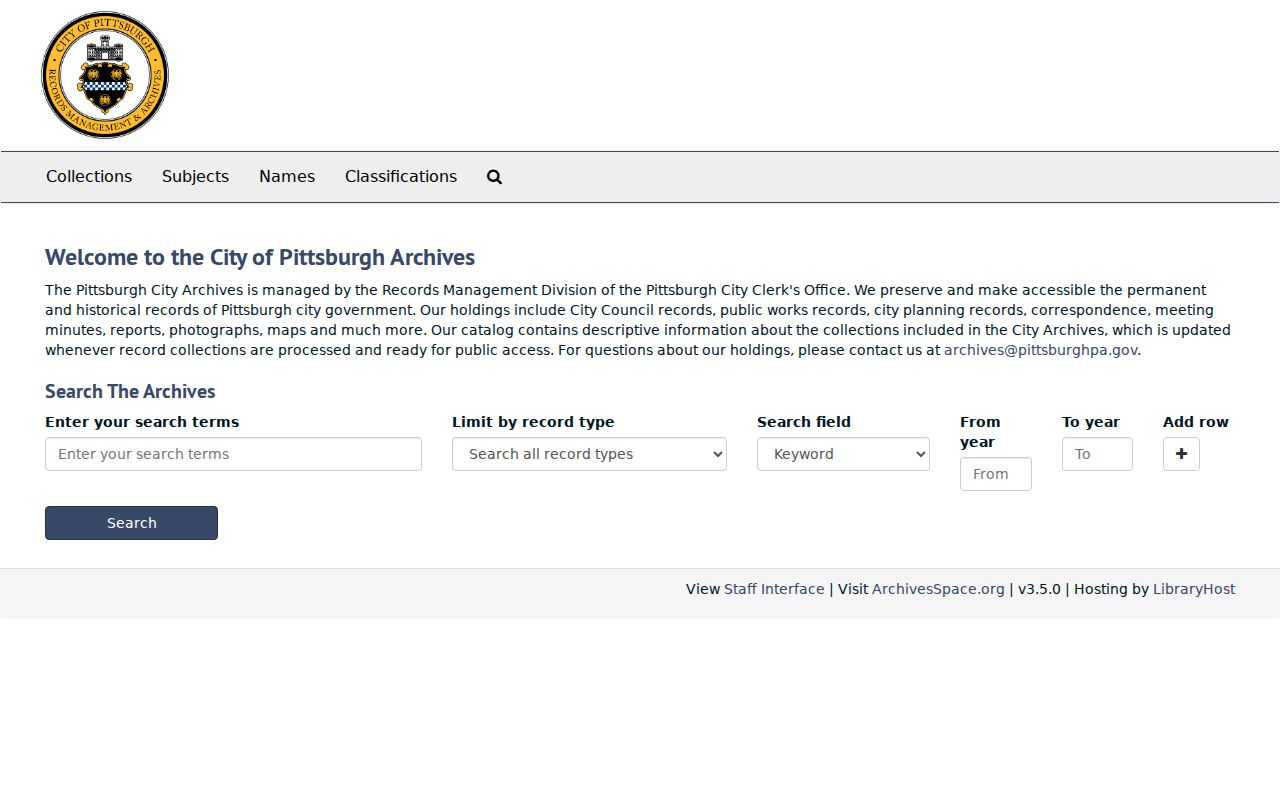
The catalog shows a keyword field, record-type and search-field controls, and year narrowing. No live result was inspected, so result fields and dropdown choices should be confirmed during the search.
Pittsburgh City Directory Maps and Wards
A dated address becomes stronger when it is paired with a same-era map. Historic Pittsburgh's G. M. Hopkins collection has 47 volumes and more than 1,800 plates covering 1872 through 1940. A plate can show lot and block numbers, street names and widths, property-owner names, churches, cemeteries, schools, railroads, and water features. Use the plate's date and ward context with the directory date. Do not carry a later owner name backward onto an earlier map.
This geography is especially valuable in a city of 90 neighborhoods. A ward, plan, lot, or map plate can distinguish similarly named streets and explain why a familiar address is not a match. The map is context for the dated entry, not a substitute for a deed or a directory volume.
Pittsburgh Fire Records Detour
The Great Fire of April 10, 1845 burned 982 buildings, including the mayor's office and most City records from 1843. More than 2,000 families were displaced, while Fire Relief Committee correspondence and payments from 1845 through 1849 survived. A missing City administrative record near those years may reflect that loss. It does not mean County deeds or every historical record vanished.
When the City trail stops, try a directory volume, newspaper, Hopkins plate, probate record, recorded deed, or County source that fits the same period. That is a records detour rooted in Pittsburgh's own custody history, not a reason to fill a missing fact with a guess.
Pittsburgh Directory Research Boundaries
Carnegie Library's obituary and death-notice request route can help close a historical trail. Its form covers Pittsburgh and Allegheny County index periods of 1786 through 1913, 1963 through 1998, and 2001 to the present. Requests go by email or mail to the Pennsylvania Department at Carnegie Library, and the form estimates a four-to-six-week response. No fee is stated on that form, so it should not be described as free.
For older birth and death registers, Carnegie documents Pittsburgh coverage from 1870 through 1905 and a $5-per-name research fee. The Western Pennsylvania Genealogical Society also identifies local surname, church, cemetery, naturalization, and Sanborn-map resources, with availability to confirm before travel. These channels are better suited to a family-history question than treating a historic entry as proof of a living person's location.
Note: Keep a source citation, volume year, page, and repository with every historical finding so another researcher can retrace the connection.