
Pittsburgh Resident Lookup Records
No single file verifies a Pittsburgh resident. The public Allegheny County Real Estate Portal is an address or parcel-number route and can show assessment, tax, building, sale, and mailing clues. Its owner-history display is incomplete. The Department of Real Estate, or DRE, is the separate title-record source. A court docket, marriage file, will request, or vital record serves a different purpose. Start with the most precise fact already known, then compare an independent record with a date, place, or role.
| Record channel | Fact it can test | Local custodian | How access works |
|---|---|---|---|
| Property record | Physical location, tax and mailing fields, sale clues | Allegheny Office of Property Assessments | Public address/PIN portal; owner history has limits |
| Recorded instrument | Grantor, grantee, date, document, book/page, PIN | Allegheny DRE | Public land-record search, counter, or mail route |
| Court docket | Party role, case, date, and status | Fifth Judicial District / UJS | Free docket and calendar search; exclusions apply |
| Marriage record | Marriage identity link | Allegheny Marriage License Office | Name and year are required; 1996+ online search/order |
| Vital record | Dated birth or death fact | PA Division of Vital Records | Certificate eligibility or archival access rules |
A recorded party is not automatically a current resident, and a mailing field need not be the physical address. Keep that distinction throughout a Pittsburgh resident lookup. If the question is title history, carry the PIN, recording date, and book/page from the property record to DRE instead of treating one assessment result as a complete answer.
Pittsburgh Court Lookup by Name
The free Pennsylvania UJS Case Search is the proper first court screen for a Pittsburgh name. Use Participant Last Name and Participant First Name, then select Allegheny County or judicial district 05. Add a filing-date range, docket type, category, or status only when it helps separate similar names. The portal also provides searches by docket, citation, complaint, incident number, organization, calendar event, and other fields, but a precise local name is usually the least invasive starting point.
Read a result as a docket, not a full court file. A typical visible sheet can show the court or magisterial district, docket number and caption, OTN, complaint number, dates, participant section, charges or dispositions, docket entries, calendar events, and financials. Recent activity can be delayed. Juvenile, sealed, expunged, limited-access, and other protected material is not displayed. For a document that the public docket does not provide, use the correct court division rather than an open-records request.
| Same-name check | Compare the participant role, court, date, county, and case status before associating a result with a Pittsburgh resident. |
|---|---|
| Historic civil lead | Department of Court Records indices include General Judgment, Ejectment/Miscellaneous, In Rem Cities, and pre-1995 material. |
| Counter path | Allegheny Court Administration accepts public-access inquiries at 340 Frick Building, 437 Grant Street, Pittsburgh, with appointment requests for a specific Magisterial District Judge. |
Note: Court names identify a party’s recorded role, not a current address, relationship, or full personal history.
Pittsburgh Addresses and Recorded Owners
When an address is already known, use it to test a recorded property role, not to name every person at that location. The County portal separates Physical Property Location, Owner Mailing, and Tax Mailing. A mailing value can point elsewhere, including to an escrow arrangement. Preserve the PIN, legal description, sale or recording date, and any deed book/page. Then use the DRE land-record search to test the recorded chronology.
The County GIS viewer supplies parcel geometry and can search a full address, PIN, or map-block-lot value, but its parcel layer does not contain owner fields. That split is useful: GIS locates the parcel, the property portal supplies assessment clues, and DRE supplies the recorded instrument trail. A Homestead = YES value may reflect a prior owner, so it is not evidence of present occupancy. For a street-wide sequence rather than one person, use the Pittsburgh street directory route after the address is confirmed.
Pittsburgh Marriage Records as Links
Allegheny marriage records begin in 1885. The Marriage Records office asks for one spouse’s complete application name and the marriage year. Licenses from 1996 forward have an online search and order route. Earlier records can still be ordered online with a search fee, even when no record is found. A plain copy is listed at $4, and a failed search is also $4.
Historical applications can contain the applicants’ names, ages, residences, occupations, and birthplaces. From 1915, they can add parents’ names, occupations, and birthplaces. Those facts make a marriage file a useful dated identity link, not proof of a current Pittsburgh residence. The counter is in the City-County Building at 414 Grant Street, and the office also provides online, mail, and phone channels.
Allegheny County’s marriage-record access page shows the official ordering route used for this Pittsburgh resident lookup record.
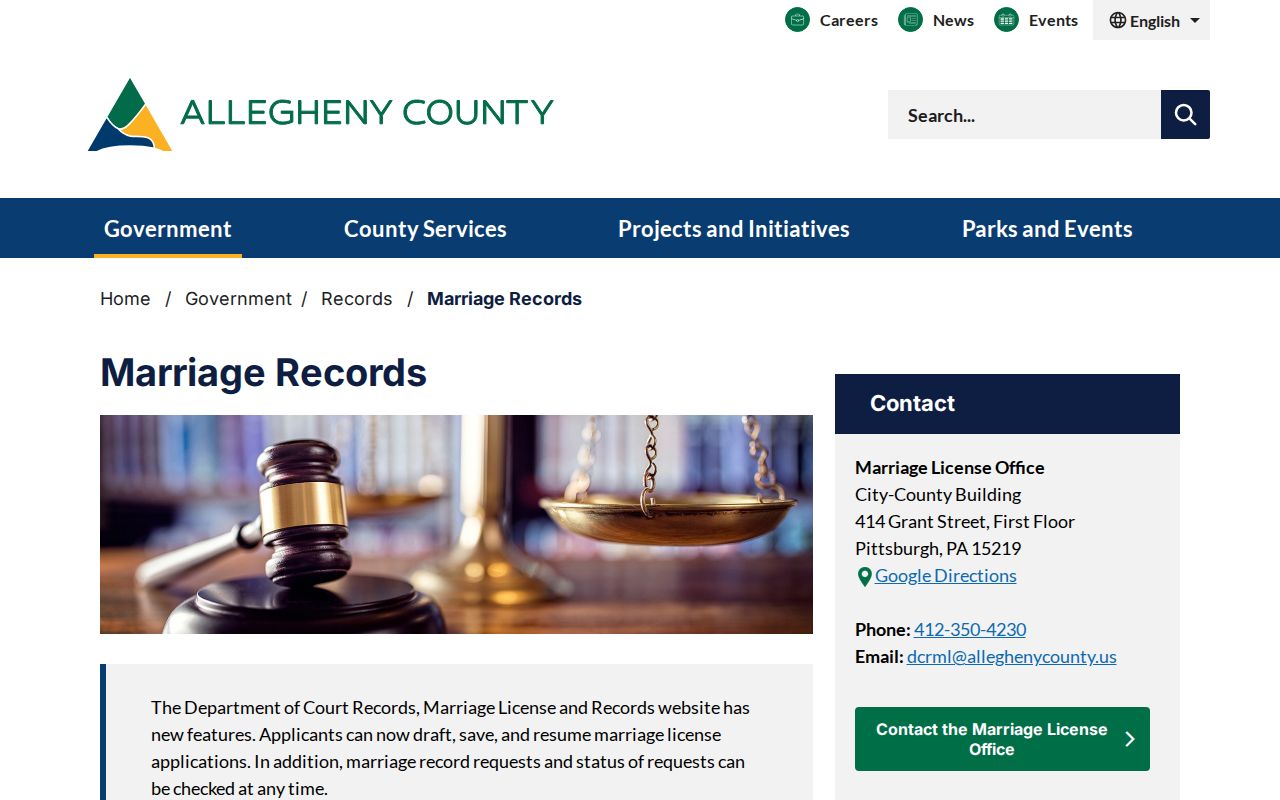
The access page is a reminder to bring a full application name and year, then keep the returned marriage fact in its proper date range.
Verifying Pittsburgh Resident Records
Verification is a short chain of independent checks. Begin with a known address or parcel, then preserve the date and record identifiers before adding a court, marriage, probate, or vital source. Do not combine two people just because the name matches. A surname spelling, time period, municipality or ward, case number, title role, marriage year, or legal description can separate one person from another. Record where each fact came from, because a later correction or new document may change how the match should be read.
- Use the County property portal only after an address or PIN is known. Record the physical location separately from owner and tax mailing fields.
- Carry the PIN, book/page, party name, and recording date into DRE. Compare a title party’s chronology rather than assuming a current location.
- Search UJS with the name narrowed to Allegheny. Test the court, party role, and dates against the property or document facts.
- Use a marriage, vital, or probate channel only for the dated fact it holds. Request the custodian’s copy or clarification when records conflict.
- Docket
- A court’s running case record, showing filings, events, parties, and outcomes that are available to the public.
- Index and image
- An index points to a record through names or identifiers. An image is the document scan, which may have different access or copying rules.
- Certified copy
- A copy issued and authenticated by the custodian for the record’s official purpose, not merely a search-screen result.
Note: A verified result needs both a matching identity detail and a date that fits the record’s purpose.
Pennsylvania Vital Records for Pittsburgh
The Pennsylvania Department of Health Vital Records program holds birth and death records from 1906. A current birth certificate costs $20, with an added $10 for the authorized online service; the Department lists mail, online, and branch-office routes subject to eligibility, identification, and signature rules. Death certificates also cost $20 plus the online-service charge. The Department distinguishes certificates with and without medical information for deaths after 2019.
For family-history work, access changes with time. Birth records become public after 105 years and death records after 50 years under the Vital Statistics Law, 35 P.S. §450.801. The Pennsylvania genealogy service directs older public research to historical index material, including births for 1906–1913 and deaths for 1906–1968 at PHMC. A ten-year birth search is $45, with $25 for each added decade, when the date is uncertain.
Marriage records take the County route, while divorce is a Department of Court Records file. A vital certificate, marriage record, or court docket should remain a dated fact in a Pittsburgh resident lookup. None establishes where someone currently lives.
Allegheny Will Leads for Families
For an estate or heir question, Allegheny Wills & Orphans offers a defined request path. Its will-search form asks for the decedent’s name and death date, along with the requester’s contact details. Send the form with a $10 money order. The fee is nonrefundable whether or not a record is located. This is a documented lead for family and estate research, not a promise of a full list of heirs or their current locations.
The office is on the first floor of the City-County Building, 414 Grant Street, and accepts counter, mail, phone, and fax contact. Probate facts can help distinguish two same-named Pittsburgh residents when matched to a date, a known family connection, or another custodial record. A nonresult does not close the family-history question. It can mean the date is wrong, the file falls outside the request’s scope, or another archive, marriage record, or historic directory supplies the next dated lead. The original will or court file may contain access limits that a search response cannot resolve.
Pittsburgh Resident Lookup Limits
Pennsylvania records have different privacy rules. The Right-to-Know Law presumes agency records open unless an exception or other law applies, but it does not override court-file procedures, vital-record eligibility, voter-list restrictions, 911 confidentiality, or protected addresses. The Pennsylvania Address Confidentiality Program provides an alternate mailing address through a safety plan for eligible participants. It is not a general removal mechanism for every older public source. A missing result should be respected as a limit, not treated as permission to infer or publish a protected fact.
Restricted UJS material, vital-record rules, and voter protections can make a result unavailable. A voter registration-status tool is for individual status, not casual name browsing, and formal voter-list requests carry separate identification, fee, use, and publication limits. Correct an address through the municipality or County Address Management, a docket through the court, a registration issue through elections, and a vital-record issue through the Department of Health.
Lawful use. Use Pittsburgh resident lookup records for personal, lawful research. Pennsylvania prohibits specified harassment, stalking, and intentional disclosure of restricted personal information for intimidation or threat.
Note: When an official source withholds a fact, use the custodian’s stated process rather than trying to infer the protected information.